Showing posts with label Arms. Show all posts

Tuesday, November 4, 2014

Best Triceps Exercises for Mass


The triceps brachii muscle (Latin for "three-headed arm muscle") is the large muscle on the back of the upper limb of manyvertebrates. It is the muscle principally responsible for extension of the elbow joint (straightening of the arm).
The long head arises from the infraglenoid tubercle of the scapula. It extends distally anterior to the teres minor and posterior to theteres major.

Thursday, August 28, 2014

TOP EXERCISES FOR GREAT AND SEXY BICEPS

In the event that there's one thing that attracts individuals to weightlifting and perhaps weight training in general – its getting greater muscles to show off. Biceps are one of the top muscles that individuals need to have protruding and flexing at all times. It's one of the principle muscles that individuals can just see – so when you discover somebody looking at them, you can wink and give a little nod of fulfillment.

Thursday, July 17, 2014

BUILD HUGE ARMS THAT POP OUT FROM YOUR T-SHIRT SLEEVES

Big veiny arms are something that all men secretly want to have. It’s also something that all women secretly want their men to have.

Because it makes you look strong and it usually means that you are strong. And who doesn’t want to look strong?

That’s the reason why there’s always someone doing bicep curls in the gym. Everytime I walk in

Thursday, April 24, 2014

BOOST YOUR BENCH PRESS, SQUAT, AND DEAD-LIFT

Mastering the three basic lifts is essential for building an awesome body. Learning these variations can turn awesome to amazing.

When it comes to building muscle and strength, three exercises can kick sand in the face of pretty much any other move out there. I'm talking about "the big three" for getting big: the squat, bench press, and deadlift.
Unfortunately, performing these exercises endlessly can lead to stagnation—
mental and physical—and once your brain hits the exit, your gains are likely to go on hiatus, too.
Sure, you could ditch these exercises for a while and embark on an entirely new program to shake things up, but these are awesome moves and gym staples for good reason.
So, I have plan that can give you the best of both worlds: the gains these exercises undeniably and inevitably produce, but enough variety to hold your interest, too. Try these variations after your basic sets for the big three exercises. It's as simple as that—and the resulting gains will amaze you.
The muscle-making and strength-building magic happens in three basic ways:
  • You do more work than before, which leads to progress.
  • Your body adapts neurologically, which leads to even more progress.
  • Your work on the variations will improve your technique on the originals.
Check out these variations for each of the big three lifts, and learn how you can implement them to elevate your training and improve your physique!

1
 DEADLIFT VARIATIONS

Complete your planned rep and weight scheme of deadlifts, and then try one of the following variations:

DEFICIT DEADLIFTS

This variation is for more advanced lifters and is designed to help increase the range of motion. Basically, elevate your feet 1-2 inches off the ground and pull from there. You can stand on top of 45-pound plates, use hard mats, or a short box.

DEFICIT DEADLIFT

When performing the deficit deadlift, I recommend dropping the weight by 10-20 percent. The set and rep scheme would be identical to that of your deadlift off the ground.

ROMANIAN DEADLIFTS

Drop the weight 10-20 percent and perform 3-5 additional sets of 3-8 repetitions.

BLOCK PULLS

Blocks pulls are not to be confused with rack pulls, which use the power rack. Placing the bar on the pins of a power rack takes any slack out of the bar and changes the lift drastically.
For a block pull, simply elevate the plates 1-4 inches off the ground by using mats, blocks, or even other 45-pound plates. Then either use the same weight as you did on your last set or add up to 10 percent to the bar.
Complete another few sets at the same number of repetitions you used for deadlift.

2
 SQUAT VARIATIONS

Similarly, after crushing your regularly scheduled squats, you could work in one of these variations for getting out of particularly troublesome sticking points:

PAUSE SQUATS


"BRUTAL IS ONE WAY TO DESCRIBE THE PAUSE SQUAT."
Brutal is one way to describe the pause squat. Brutally effective, that is. A pause squat is just as it sounds: an ever-so-slight pause at the bottom, then bounce right back up.
I recommend dropping the bar weight by 10-20 percent and performing a few more sets at the same rep range this way. One to three seconds at the bottom more than suffices.
The paused position should be where you actively hold the weight up, not in the fully rested position. If you drop to the verybottom, you'd most likely engage the end range of your joints to create stability, but not so much your muscles to create the much preferred "active" stability.

PIN SQUATS

Try squatting from the pins. The pins change the nature of the exercise by removing the lowering (eccentric) portion. To set these up, move the safety pins in your squat rack so they hold the bar in a position where you are at or about 1-2 inches above parallel.
With the pins set and the bar loaded, dip yourself under the bar and into a proper position to squat the weight up. Maintain the same bar weight as you did for reps—keeping between 60-80 percent effort—except now perform only single reps.

3
 BENCH PRESS VARIATIONS

The bench press is a gym standard, but a few key variations can help push you past sticking points, should they arise. If you're keen on improving your bench press, try using one of the following:

FLOOR PRESS

Essentially a bench press from the ground, the floor press doesn't make the bench press any easier. Quite the opposite! The nature of the position nearly eliminates the drive of your legs and the arch of your back. The upshot is that this exercise will add productive volume to your upper body and contribute to an improved bench press.
To set up a floor press, simply move what are called the "J" hooks in your squat rack so they sit just low enough that you can un-rack the bar from a lying position on the floor.
From there, drop the bar weight by about 10-15 percent and perform a few more sets after the bench press, using the same number of repetitions you did with the standard bench press.

PAUSED BENCH PRESS/BENCH PRESS FROM PINS

The same guidelines as the pause squats or pin squats apply here. In this case, pause the bench press on your chest for the allotted time or set the safety pins about 1-2 inches above your chest.
Drop the bar weight by 10-20 percent and perform a few more sets at the same rep range with one of these two variations.

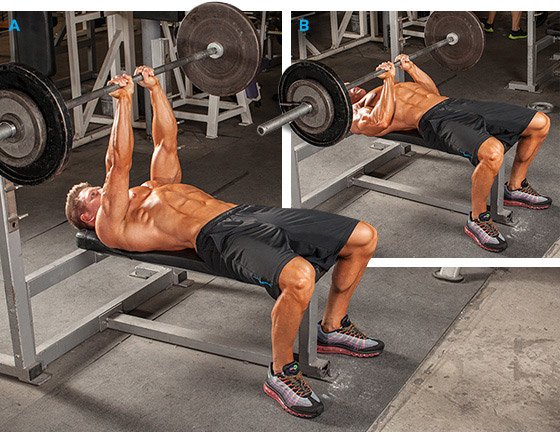
CLOSE-GRIP BENCH PRESS

Bring your grip a few inches closer together and perform the press with the same movement as normal. Just be extra careful about keeping your elbows tucked so they remain under this narrow hand spacing.

CLOSE-GRIP BARBELL BENCH PRESS

Drop the weight by 10-15 percent and perform a few more sets of close-grip bench presses using the same repetition numbers as the standard bench press.
Now go out and give these a try!
bodybuilding.com

In the Crosshairs: Brachioradialis

Lagging forearm muscles are a common weakness. It’s often difficult to find the time to work in forearms, so most guys forego the forearm training in hopes that all the back and biceps work will stimulate enough growth. Yet, even if you do throw in some forearm work, you may not be doing it properly. The brachioradialis is the large major muscle on the top of your forearm. To hit it
properly, you should be doing reverse-grip curls. But to make sure you place less stress on the brachialis (upper-arm muscle deep to the biceps) and more on the brachioradialis, you want to be sure to do reverse-grip barbell curls with a thumbless grip.
  • Alternatives: Reverse-grip dumbbell curls with a thumbless grip, reverse-grip cable curls with a thumbless grip.
WHEN TO GO THUMBLESS: To focus on the brachioradialis, do reverse-grip barbell curls with a thumbless grip (thumbs on the top side of the bar) at the start of your forearm training, immediately after biceps. This better targets the brachioradialis, because the thumbless grip forces you to keep the barbell close to your torso so that your fi ngers remain under the bar. In essence, you do a reverse-grip drag curl, which removes the stress from the brachialis and places it on the brachioradialis. Doing it first in your workout is best, because your grip is strongest, which will allow you to go heavier and place more overload on the brachioradialis.
FORM AND FUNCTION
The brachioradialis starts on the humerus (upper-arm bone) and attaches to the radius (forearm bone). This is the large muscle on the thumb side of the forearm. When it contracts, it flexes the arm at the elbow joint, especially when the arm is pronated (wrist turned in).
FLEX

Sunday, March 30, 2014

Strong Arm Tactics

It wasn’t always like this. When I first met 20-year-old Flex Lewis in the autumn of 2004, the Welsh Dragon was undefeated in physique contests in his native United Kingdom. But all the focus was on his pro-caliber legs (those calves!) and pleasing structure. His arms were his most glaring weakness. Cut to the autumn of 2012 when he won his first Olympia 212 Showdown title. His biceps
and triceps had completed their improbable journey from debilitating weakness to pose-winning strength. In fact, they were so large that he rarely trained them in 2013 on his way to his repeat Olympia 212 Showdown victory.
Flex Lewis turned 30 on Nov. 15. People still talk about his calves. But they’re no longer all people talk about. Because he so often flexes his arms in photos for fans, they now garner much of the attention. If observers remember him when he first burst onto the bodybuilding scene nine years ago in the March 2005 pages of FLEX, they surely wonder how the Welsh Dragon could’ve transformed his weakness into a strength and what he does to maintain arm superiority.

MIND TO MUSCLE

Over and over again when I hear bodybuilders speak of bringing up weak points, the most important factor is the mind-to-muscle connection. It’s as if at some point the proverbial light bulb went of and they forgot about the weight and started truly focusing on the muscle. Typically, they’d spent too much time hoisting ever-heavier metal, and they never truly connected with the body part. Then, when they reduced the resistance and learned how to feel their targeted flesh working from stretch to contraction on every rep, their gains increased substantially. “I’ve just recently learned how to really hit my chest so my front delts don’t take over,” Lewis states. “Arms were the first area where I really learned how to focus on them in a way I was missing before.
“Before, my forearms would always take over. And then I started doing certain exercises and really squeezing, and I became less concerned with the weights. And over time I taught myself to squeeze and get connected with the muscles, and the weights obviously came back up with time. That mind-to-muscle connection was the most important thing. Another thing I did was I trained biceps on their own days, and I trained triceps on their own days. So I gave a lot of time to my arms each week, and I hit biceps and triceps alone to really focus on each muscle.”

GIANT PUMP

Today, Lewis trains triceps and biceps together, beginning with the former. But he relies on a technique he adopted years ago to make certain his triceps are warmed up, isolated, and maximally pumped. By utilizing the Weider Giant Set Principle, he attacks his tri’s with five isolation exercises in rotation. Giant sets can be difficult to perform if you need to rush from one station to the next. However, Lewis can do all five of his exercises in the same spot with the same overhead cable. He starts with rope pushdowns, spreading the rope ends as wide as possible at contractions.
Then come rope extensions, keeping the ropes together throughout each rep. (Because this pushdown method is easier than the first, he can use the same weight for both exercises.) Then he replaces the rope with an EZ-bar handle. He does one set of pushdowns overhand and another set (with a lighter weight) underhand. Finally, he turns around and faces away from the weight stack, grabs either the EZ-bar or the rope, leans forward, and presses the bar out, parallel to the fl oor, cranking out cable triceps extensions.
Lewis tallies 20 reps of each exercise, only halting the toil long enough to shift his position or switch in a different handle. He pauses for two minutes between giants sets. “I always do a warmup giant set,” he states. “And then I do three or four working giant sets. So, all told, including warmups, I’m doing either 400 or 500 reps in short order. Afterward, my triceps are already fully pumped, and I’ve spent a lot of reps targeting strong contractions to really focus on my tri’s.”

COMPOUNDING THE PAIN

After doing five isolation exercises in 100-rep rotations, Lewis has pre-exhausted his triceps. So next up he thoroughly toasts his tri’s with two compound exercises: close-grip bench presses and dips. Both of these also hit the chest and front deltoids, but after his 400- or 500-rep cable barrage, his arms are going to give out long before he taxes anything else.
“With close-grip benches, I pyramid, using heavier weights and fewer reps. I go to no fewer than eight reps, and I may get forced reps on the last two. I tend to use the Smith machine. I flip an incline bench (set in the flat position) around. And I angle the seat part up, and that’s where I put my head. That way, I can more easily watch what’s happening. My grip is set by touching my thumbs. So I take a grip that is about two thumbs apart. Some people who are taller than me may have two inches between thumb-to-thumb, but anything more than that I think hits the chest more and the triceps less. And if I use the Smith machine, I come down to the lowest part of my pecs. I just feel that gives me the best stretch for my triceps.”
Of his other compound triceps exercise, Lewis avers: “I love dips. I do these with just my body weight. I try to get high reps, and I go to failure on every set. I try to eliminate my chest as much as I can. I use dips on chest day, but then I dramatically lean forward. For triceps, I keep my body as upright as possible. If I don’t do body-weight dips, I’ll do machine dips. Again, I keep my rep-range to 20-plus. But I tend to squeeze a lot more on these, especially on the final two or three reps of sets. I’ll hold and squeeze as hard as I can.”

BICEPS BASICS

“I love dumbbell curls,” the Welsh Dragon opines. He begins his biceps routine with standing alternate dumbbell curls. “A lot of people just throw the weight up. Myself, I try to get a full range of motion, and I turn my hand as much as I can, and hold for a second and squeeze.” The turning of the wrist from palms facing the body’s center plane to palms facing backward and then tilted slightly outward is known as supination. In addition to elbow flexion, this is the other key function of the biceps.
Doing a dumbbell curl without supination is like eating cake without the icing, because that wrist twist is the greatest advantage of dumbbell curls over two-arm curls. After three or four sets of alternate dumbbell curls, Lewis follows with two sets of curling the dumbbells simultaneously.
The world’s best 212-or-under bodybuilder performs two other free-weight basics for biceps: EZ-bar curls and hammer curls. When doing the EZ-bar curls, he is cognizant of always getting a slight squeeze at contractions. The hammer curls are done seated and alternating his left and right arms. Hammer curling, which works the brachioradialis of the lower arms in addition to the biceps and brachialis of the upper arms, is as close as the Welsh Dragon gets to training his forearms—which are among the best of all time. As with most arm exercises, he keeps the reps relatively high—in the 12–20 range—on both EZ-bar curls and hammer curls.

OVER 21

Between the EZ-bar and hammer curls, Lewis is likely to switch it up, doing a non-free-weight exercise with an unorthodox rep range. He likes two-arm cable curls with an EZ-bar handle. But there are two factors that make these unique. First, he makes them 21 curls: seven reps that go from full stretches to halfway up, followed by seven reps that go from halfway up to full contraction, topped off by seven full reps.
This intense rep scheme is enough for most bodybuilders. But the two-time Olympia 212 Showdown champ doesn’t stop there. He tops it off with several rest-pause reps. These are performed by pausing just long enough after each rep to regain the strength for another rep. “I may get three, may get five, may get more,” he states, “but every one of those reps is exploded up and then squeezed at the top, and I get a semi-negative on the way down. I lower as slow as I can, but after the 21s my arms are spent, so it’s hard to go real slow.”

DOWNPLAYING

As evidenced by the preceding routine, when Flex Lewis would hit arms over the past year, he put his everything into those workouts. And this was the style of training—higher reps, greater intensity, a focus on contractions and staying connected to the muscles—that brought his arms up so much he rarely needed to work them in 2013. “I didn’t really train triceps or biceps much going into the last Olympia,” Lewis states. “They were being hit with chest and back. They got a pretty good pump on those days. But I didn’t want them to get too big. They’ve come up so much that they’re now a strong point. So this was the first year that I focused a lot less on arms.
“In the past, there was a time when I was focusing extra on them, because they were considered a weak point. But now I’ve reversed that. I don’t really want to be walking around with ridiculously oversize arms. My thing is all about proportion. I could probably put another inch on my arms in a year if I trained them as much as my chest, but I would rather focus more on my chest and less on my arms and keep things in proportion. But I remember it wasn’t that long ago when I put extra effort into arms. And whenever I train them, I still train that same way. Arms were the body part that I busted my ass to build up—and it worked.” FLEX

Wednesday, March 5, 2014

Arnold shows how to peak the Biceps

Arnold shared a tip for creating massive peaked biceps too. "Concentration curls is one of the best exercise for maximizing the biceps' peak." He adds.

7-time Mr. Olympia Arnold Schwarzenegger have one of the impressive biceps of all time following his routine. Do it 3 times a week, but you can do it once or twice also, depending on your own training split.

Wednesday, February 26, 2014

Build Killer Biceps

Opener
Who knew the most modest of muscles can summon a portion of the best workouts? Attempt these executioner sessions and watch your biceps develop by limits.

Sudden stunning exhibition. For most real muscle gatherings, squashing the bodypart with substantial weight is sufficient to start genuine change. Anyway in the matter of the littler muscles like the biceps, burden will just get you so far not far off of advance. Truth be told, we're

Friday, February 21, 2014

6 Favorite Mass Exercises - Ronnie Coleman, 8 Time Mr. Olympia

Let's get right to the guts of the matter. I could run through my list of favorite workouts, principles, techniques and combinations of exercises, but it all comes down to one basic old-fashioned “best” exercise for each bodypart, without which you cannot reach your maximum mass potential. That exercise is not the only one in the workout, but it’s the foundation
movement. It works more of the muscle harder, heavier and more thoroughly than any other. Not every workout has to start with one of these favorites, but your training program should be designed around them.
My favorites will come as no great surprise. You’ve probably been doing them all along. I just want to emphasize their importance and persuade you to give them even more prominence in your workouts by reiterating why they are the best and how to get the best out of them.

CHEST - BENCH PRESS

WHY: No other exercise synergizes the entire complex of chest muscles as efficiently as barbell bench presses. This movement is so compound (requiring the coordination of pectoral muscles with all ancillaries and tie-ins to shoulders, traps, arms and midsection) that every chest muscle is developed proportionately. Bench presses facilitate the only position from which maximum compound power can be applied, which produces maximum overall mass. The horizontal position also allows the chest muscles to move through their greatest range of power.
HOW: Your mind plays a big part in getting the most for your chest from bench presses. “Think” the contractions into your pecs. As the bar is lowered, resist with your pectoral muscles. Press by contracting your pecs. I use a fairly wide grip, beyond shoulder width, to accentuate the spread of my pec muscles.
Unfortunately, today’s popular style of benching is the opposite of the correct style for chest development, in that the bar is lowered not across the chest, but to the bottom of the rib cage. The body is crunching inward, rather than expanding upward to meet the bar. This is done for leverage, but it removes the chest from the exercise.
Precisely the opposite motion should occur. The chest should rise to meet the bar, as your scapulae contract together under your back, forcing your chest muscles through their greatest range of motion.
Always pyramidyour sets gradually. I get in a couple of warm-up sets, then pyramid up through five sets, starting with 12 reps and finishing with eight.

SUGGESTED CHEST WORKOUT

WARM-UP SETS: 2-3 sets; 20-25 reps
BENCH PRESSES: 5 sets*; 12-8 reps
INCLINE BARBELL PRESSES: 3 sets; 12 reps
FLAT DUMBBELL PRESSES: 3 sets; 12 reps
FLAT DUMBBELL FLYES: 4 sets; 10 reps
*Note: Pyramid up through weights while decreasing reps.

LEGS - SQUATS

WHY: I never think of any specific muscle operating independently of any others. Each muscle has to accommodate stress vectors from every direction, in order to balance moving weight and apply variable power. This is especially true for legs. For those reasons, squats produce the greatest overall and naturally proportioned development, because all of the thigh muscles — quads and hamstrings alike — must coordinate their support, stability and strength duties throughout the everchanging dynamics of each repetition. You’re putting more into it, so you get more out of it.
HOW: Use a comfortable stance; not so wide that you’ll shear your hips, but wide enough for stability. Maintain an upright position, so the weight is directed through your hips and thighs, not into your lower back. Keep your head up, flex your traps and abs, tighten your glutes and then squeeze all the way down to “hams on calves.”
Halfway down, start thinking “up,” so that your squat movement becomes not “down and up,” but one continuous loop. Never shift gears at the bottom; you should be on your way up before you reach the bottom.
Warm up thoroughly, so your knees are well lubricated. For my counted sets, I pyramid the weight upward through five or six sets, starting with 12 reps and going all the way down to two.

SUGGESTED LEG WORKOUT

WARM-UP SETS: 2-3 sets; 15 reps
SQUATS: 5-6 sets*; 12-2 reps
LEG PRESSES: 4 sets; 8-10 reps
HACK SQUATS: 3 sets; 10 reps
*Note: Pyramid up through weights while decreasing reps.

BACK - BARBELL ROWS

WHY: Get used to the expression “compound movement,” until it becomes a beloved cliché. It’s the key to my muscle mass for every bodypart; even more so for back, since that’s the most complex muscle group of all. It needs to be developed simultaneously for thickness, width, drape and detail, and that requires very heavy three-dimensional weight resistance, which coordinates all of its muscles, as well as those of the trapezius complex. Only the barbell rowing movement accomplishes this. 
HOW: Don’t fix your back in a concave arch (swaybacked). That will only hurt your spine, reduce the range of motion for your lats and limit your power.
To hit the lats as low as possible, I try to keep my upper body bent at a 90-degree angle for the initial sets and bring the bar up into the middle of my stomach. Reps are explosive but controlled, never with a slack point at the bottom. My glutes and lower back are flexed tightly throughout the set. If they aren’t, I will feel stress more in my lower back than in my lats.
As sets pyramid upward in weight, I might have to bend my knees a bit more. This lets me absorb more shock and elevate the angle of my upper body for balance and maximum power, but my concentration remains on getting a full long pull into my gut; i.e., a full range of motion for my lats. I do four heavy working sets, from 12 reps down to seven, squeezing every contraction and feeling my back muscles pump with every rep.

SUGGESTED BACK WORKOUT

WARM-UP SETS: 2-3 sets; 10-12 reps
DEADLIFTS: 4 sets*; 12-2 reps
BARBELL ROWS: 4 sets*; 12-7 reps 
T-BAR ROWS: 3 sets; 10-12 reps
PULLEY ROWS: 3 sets; 10-12 reps
*Note: Pyramid up through weights while decreasing reps.

SHOULDERS - SEATED MILITARY PRESS

WHY: For separation of each deltoid head, I train them individually. For maximum mass and width of my entire shoulder girdle, and for full development of my total deltoid caps, military presses are the only solution. A free-weight barbell proportionately spreads the stress laterally across the shoulder beam, as well as distributes it evenly from front to back. A seated position on an upright bench provides more pressing power. A machine barbell press distributes the stress across the entire width of the shoulders, but not from front to back. Dumbbells are good for isolating deltoid heads, but they do not yield the power of a free-weight barbell.
HOW: Use a grip just beyond shoulder width; not so close that your triceps do more work than your shoulders and not so wide as to prevent a full range of motion for your shoulders. Do not arch your back. Tighten your abs and your grip for stability and control.
This movement can be used in any order during your shoulder workout — first, middle or last — because no other exercise totally fatigues your shoulder-muscle complex. You’ll probably find that you are almost as strong doing these at the end of the workout as you are when you do them at the beginning.
I do four sets of 10-12 reps.

SUGGESTED SHOULDER WORKOUT

WARM-UP SETS: 2 sets; 10-12 reps
SEATED MILITARY PRESSES: 4 sets, 10-12 reps 
SIDE LATERAL RAISES: 4 sets; 10 reps
FRONT DUMBBELL RAISES: 4 sets; 10 reps
REAR LATERAL RAISES: 4 sets; 10 reps

TRICEPS - LYING EXTENSIONS

WHY: This is not necessarily the most important triceps exercise, but it’s my favorite for pulling the horseshoe of muscle down the back of my arm, so my triceps look like a separate bulging twisted-steel bodypart of their own. Lying extensions offer a combined advantage of focusing heavy compound weight and concentrated stress into the triceps complex, without sapping energy to stabilize the rest of the body.
HOW: It is important to keep your elbows pointed straight up. Do not allow your arms to rotate at your shoulders. Doing so brings your chest and shoulders into the movement and robs your triceps of the extension. Think only in terms of extending your forearms vertically, with your elbows as the only hinge.
I get the best pump from these with six sets, 12 reps per set, in the following manner: do one set, release it, take a breath, do a second set, release it, take a breath and do a third set. After a brief shakeout, repeat that sequence.

SUGGESTED TRICEPS WORKOUT

LYING EXTENSIONS: 6 sets; 12 reps
SEATED FRENCH CURLS: 4 sets; 12 reps
WEIGHTED DIPS: 4 sets; 25 reps

BICEPS - PREACHER CURLS

WHY: This may not be the most important biceps exercise, but it’s my favorite. For maximum size and overall biceps belly mass, do standing barbell curls, but for maximum peak, hardness and split, nothing beats the concentrated pump from preacher curls. It packs my biceps so hard that they end up feeling as solid as forged steel. I credit preachers more than any other exercise for the hardness and cannonball shape of my biceps and for the deep split in their peaks.
HOW: Use heavy weight, but stay tight and don’t fully extend your arms at the bottom; you could tear a muscle and/or hyperextend your elbows. Do not leverage the curl upward by pulling back with your body, no matter how much you’re tempted. Watch your biceps pump and harden as they flex. It’s a great motivator, and it helps keep your mind on how the muscle, not the ballast-effect of your body, functions. At the top, get a peakcontraction squeeze. Maintain a moderate pace, the same during the extension as during the curl.
For every other workout, superset preacher curls with another two-arm curling movement. For the most immediate mass production, I do four sets of eight to 12 reps each.

SUGGESTED BICEPS WORKOUT

BARBELL CURLS: 4 sets; 8-12 reps
SEATED ALTERNATE DUMBBELL CURLS: 3 sets; 8-12 reps
PREACHER CURLS: 4 sets; 8-12 reps
superset with
STANDING CABLE CURLS: 4 sets; 8-12 reps

MY FAVORITE MASS PRINCIPLES

STRENGTH | Constantly push your limits. Always try to become stronger, every time you’re in the gym, and don’t become frustrated. The stronger you become, the longer your plateaus will last. That doesn’t mean you’ve stopped growing, only that you’re going beyond normal human limits. That’s where you want to be, so keep blasting away. Eventually, you’ll break through to a new level.
DON’T CHEAT | No matter how hard you work, make sure the muscle is doing the lifting and that you’re not cheating. Feel the pump build hard and tight in the muscle you’re working, before you feel it in adjacent muscles.
THE PROPER PUMP | Concentrate on building the highest-quality pump possible: a healthy full coursing of blood precisely where you want it in the muscle. The sensation doesn’t have to be painful or numb, just a wholesome tightness in the muscle belly, telling you it’s swollen with blood under high pressure.
CONSISTENCY | Select a workout schedule and stick with it. Mass gains are a matter of commitment, as much as they are of your workout. Regardless of how hard you lift, if you’re not relentlessly consistent, it won’t work. Don’t let unscheduled rest days become a habit.
Source - FLEX

Monday, February 17, 2014

Add 1 Inch to Your Arms : In Just 1.5 months


How might you want to include 1 inch of new muscle development to your upper arms in the following 45 days? I'll wager you do unless you as of now have arms like Manfred Hoeberl. Manfred's arms have measured a genuine 26 inches in crest condition. Since arms are a standout amongst the most prevalent (if not the most famous) muscle aggregates then this article ought to be generally welcome.

Labels

Abs (9) Arms (10) Back (6) Bodytype (1) Carbs (3) Cardio (1) Chest (7) Contest (1) Core (5) Cortisol (1) Creatine (8) deadift (3) Deltoids (7) Diet (9) Exercise (53) Fat loss (11) Fitness (28) Food (15) History (1) Info (47) Insulin (3) Legs (5) Mass Building (15) Muscle building (65) Nitric Oxide (1) Nutrition (24) Pics (5) Plateau (1) POTW (1) Protein (2) Safety (4) Shoulders (2) Steroids (10) success story (4) Supplement (25) Techniques (4) Testosterone (14) tips (30) Traps (3) Triceps (1) Video (1) Weight Gain (5) Weight loss (5) Whey (2) Women (2)